
Website Strategy
What Should a Service Business Homepage Include?

A service-business homepage should help the right visitor answer four questions quickly: Am I in the right place? Can this business help me? Why should I trust it? What should I do next?
It does not need to explain every detail of every service. It does not need to carry the entire company history. And it does not need more sections simply because another business has them.
A strong homepage introduces the business clearly, helps visitors find the service or information that matters to them, reduces uncertainty, and gives them a sensible next step. The detailed selling should usually happen on focused service pages, not inside one overloaded homepage.
This guide explains what a service-business homepage should include, what should live on other pages, and how to decide what deserves priority.
Quick decision summary
- Start with relevance. The opening should clearly explain what the business does, who it helps, and why the visitor should keep reading.
- Help visitors find the right path. Introduce the important services clearly enough that a visitor can choose the relevant next page without guessing.
- Build confidence before asking for action. Use relevant proof, process clarity, and realistic scope to reduce uncertainty.
- Give each visitor a specific next step. The primary action should match the page and the visitor’s likely stage of decision-making.
- Keep detailed information on the right page. The homepage should guide the journey. Service pages, case studies, FAQs, and contact pages should handle deeper questions.
The goal is not to make the homepage longer. It is to make the next decision easier for the right visitor.
A homepage is not a brochure for everything your business has ever done
Service-business homepages often become overloaded because the business tries to explain every service, every credential, every audience, every process, and every company detail in one place.
That usually creates a page that feels busy but still leaves the visitor uncertain. They may see many sections without understanding the basic offer, whether the business is relevant to their problem, or where to go next.
The homepage has a narrower and more valuable job. It should introduce the business, establish relevance, route visitors toward the right information, and help a serious prospect feel confident enough to continue.
A detailed service page can explain one offer in depth. A case study can show evidence of a specific type of work. An About page can explain the people and background behind the business. A contact page can handle practical inquiry details. The homepage should connect those pieces into a clear first journey.
The Four-Decision Homepage Framework
In my view, a service-business homepage should help the visitor make four decisions in the right order. If the page fails at one of them, adding more decorative sections usually will not solve the underlying problem.
1. Am I in the right place?
The opening of the homepage should make the business relevant quickly. A visitor should be able to understand what the business does, who it serves, and what kind of problem it helps solve.
This does not require a clever slogan. It requires useful language. A vague line about excellence, innovation, quality, or tailored solutions may sound polished, but it often fails to tell the visitor whether the business is relevant to their situation.
For a local service business, the opening may need to make the service area clear. For a professional firm, it may need to make the client type or specialization clear. For a consultant, it may need to make the type of business problem clear. The details will vary, but the visitor should not need to decode the offer.
Before adding any other homepage section, ask: could the right prospect explain what this business does after reading the first part of the page?
2. Can this business help with my specific need?
Once the visitor understands the general offer, they need a clear route toward the service, audience, location, or situation that matters to them.
A business with one primary service may be able to lead visitors toward one focused service page. A business with several distinct services should introduce those services in a way that helps visitors choose the right path.
The homepage should not repeat every detail from those service pages. It should give each service enough context for a visitor to recognize the right option and continue to a page that answers the deeper questions.
For example, a service section should not simply list service names with identical “Learn More” buttons. It should make clear who each service is for, when it is relevant, and what problem it is intended to solve.
When the service structure is unclear, thin, or disconnected from buyer questions, the first requirement may be stronger SEO website content rather than a visual redesign.
3. Why should I trust this business?
Visitors do not need every possible trust signal at once. They need enough relevant evidence to feel that the business is credible, organized, and suitable for the decision they are considering.
Useful trust information may include verified reviews, relevant case studies, named expertise, clear process information, service-specific experience, realistic explanations of scope, useful FAQs, or examples of work where those examples are genuine and relevant.
The important word is relevant. A visitor considering a complex professional service may care about process clarity and expertise. A local service customer may care more about availability, service area, proof of work, and how to request help. A generic badge wall or unrelated testimonial can take space without helping the actual decision.
Trust is not created by decorative logos, unsupported claims, or stock imagery. It is created when the page answers the doubts a serious visitor is likely to have before they contact the business.
4. What should I do next?
A homepage should not leave the visitor with a vague instruction to “Get Started.” The next action should make sense for the business, the service, and the visitor’s level of readiness.
A visitor who understands exactly which service they need may be ready to request a quote or book a consultation. A visitor who is still comparing options may need to review service pages, see examples of work, or understand the process first. A business owner who knows the site is underperforming but cannot identify why may need an audit rather than a generic project inquiry.
The homepage can support more than one visitor path, but the actions should be deliberate. Each action should tell the visitor what will happen next and why that step is appropriate.
What belongs on the homepage and what belongs elsewhere?
| Information | Homepage role | Better place for the full detail |
|---|---|---|
| Your main offer and the audience you serve | State it clearly and early. | Service pages can explain the offer in full depth. |
| Important services | Introduce and route visitors toward the relevant service. | Dedicated service pages should handle scope, process, FAQs, proof, and specific actions. |
| Trust and proof | Show the most relevant evidence that helps a visitor continue. | Case studies, testimonial pages, portfolios, and About pages can provide fuller context. |
| Your process | Give a short explanation of how working with you begins. | A process page or service page can explain detailed steps, requirements, and expectations. |
| Company background | Include only what helps establish immediate credibility or relevance. | The About page should carry the fuller story, values, team, and background. |
| Detailed questions and objections | Answer the most important questions only when they help the homepage decision. | Service pages and focused FAQ sections should handle deeper or service-specific questions. |
| Contact and inquiry details | Make the next step visible and easy to understand. | The Contact page can collect the details needed for a serious inquiry. |
This distinction matters because a homepage becomes weaker when it tries to replace every other page on the website. The goal is not to hide useful information. It is to place information where it can do its best job.
What should appear first on a service-business homepage?
There is no universal homepage order, because a local contractor, consultant, law firm, accountant, coach, clinic, and specialist provider may need different emphasis. But the priority should usually follow the visitor’s decision process rather than the owner’s desire to show everything at once.
- Clear primary message. Explain what you do, who you help, and why the visitor should continue.
- Relevant service route. Help visitors find the service, audience path, location, or problem that matches their situation.
- Decision-support information. Clarify the business value, service fit, and what makes the offer relevant.
- Relevant proof and process clarity. Reduce the doubts that could stop a serious prospect from moving forward.
- Specific next action. Give the visitor a clear way to request help, discuss a project, review services, or take another logical next step.
Secondary content should support this sequence. It should not interrupt it. Blog excerpts, social feeds, unrelated company updates, oversized image galleries, and decorative sections should earn their place by helping a real visitor decision.
Homepage structure should match the business model
A homepage for one focused service should not be structured the same way as a homepage for a business with several service lines. The right structure depends on how visitors decide what they need.
| Business situation | Homepage priority |
|---|---|
| One primary service | Lead with the specific offer, the audience or problem it serves, relevant proof, a short explanation of how it works, and one clear next action. |
| Several distinct services | Lead with the overall business value, then help visitors choose the relevant service path without forcing them to read every service description. |
| Local service business | Make the service type, service area, practical next action, and relevant trust information easy to find. |
| Professional or advisory business | Prioritize the client type, the problems handled, expertise, process clarity, and the route toward a serious inquiry. |
| Campaign-specific offer | Use a focused landing page when one audience, one offer, and one action matter more than a broad business overview. |
This is why copying another business’s homepage section by section is unreliable. The structure should follow your visitor’s questions, your actual services, and the decision you want the page to support.
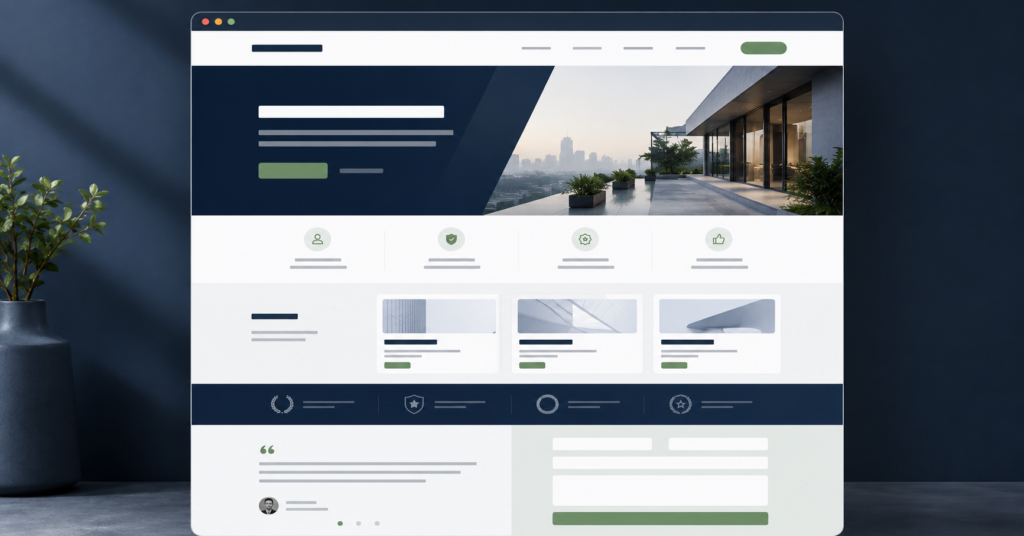
Common homepage mistakes that create confusion
- Leading with a slogan instead of a useful offer. Visitors should not need to scroll or decode abstract language before learning what the business does.
- Listing services without helping visitors choose. A service grid is not enough if every option looks identical or lacks a clear purpose.
- Showing generic proof without context. Trust information should support the decision the visitor is making, not simply fill an empty section.
- Using vague actions. “Learn More” and “Get Started” are weak when the page does not make the next action obvious.
- Trying to explain everything on the homepage. Important detail should be available, but it should not bury the primary message and visitor path.
- Adding sections because a competitor has them. A section should remain only when it helps explain the offer, build relevant trust, answer a real question, or guide a useful next step.
- Treating design as separate from message and structure. A visually polished homepage can still fail if the offer remains unclear and the visitor journey remains weak.
Does your homepage need new content, a redesign, or an audit?
A weak homepage does not always require a full website redesign. The right response depends on what is actually failing.
| If this is the main problem | The likely first move |
|---|---|
| The business offer is unclear, service information is thin, or the page does not answer buyer questions. | A homepage content restructure may be the right first move. |
| The homepage has one important conversion problem, such as a weak headline, unclear service route, missing proof, or confusing inquiry action. | A focused homepage repair may be enough. |
| The page structure, visual hierarchy, trust sections, navigation, and inquiry path are weak together. | A strategic website redesign may be justified. |
| You cannot tell whether the problem is message, structure, trust, search visibility, technical friction, or a combination of those issues. | Start with a website audit before committing to a larger project. |
The business should not pay for a newer-looking version of the same unclear homepage. Diagnose the real weakness first, then choose the smallest scope that can solve it responsibly.
A practical homepage review before you redesign
- Can a new visitor explain what the business does after reading the opening section?
- Is it clear who the business helps and what type of problem it solves?
- Can visitors quickly find the service or path that matches their situation?
- Does the page give each major section a clear job?
- Does the homepage show relevant proof rather than generic claims?
- Does it explain enough about the process to reduce uncertainty?
- Are the calls to action specific and appropriate for the visitor’s likely stage of decision-making?
- Can someone complete the next action easily on a phone?
- Does the page guide visitors toward focused service pages rather than trying to contain every detail itself?
- Would you feel confident sending a serious prospect directly to this page?
Frequently asked questions
Does every service business need the same homepage sections?
No. The homepage should reflect the business model, visitor needs, service complexity, and inquiry process. The framework is consistent, but the emphasis should change depending on whether the business has one primary service, several service lines, a local service area, or a more complex advisory offer.
How many services should I show on my homepage?
Show the services that help a visitor recognize the correct path. Do not try to explain every variation, add-on, or internal capability on the homepage. Detailed service information belongs on dedicated pages where the visitor can evaluate that specific offer properly.
Should a homepage include testimonials?
It can, when the testimonials are genuine and relevant to the decision the visitor is making. A few useful testimonials or proof points are usually more valuable than a large collection of vague praise with no context.
Should my homepage include links to blog articles?
Blog links can be useful when they help a visitor continue a relevant decision journey. They should not displace the core service message or send a serious prospect toward unrelated reading before they understand how the business can help.
When should I use a landing page instead of a homepage?
Use a focused landing page when one audience, one offer, one campaign, or one action matters more than presenting the full business. The homepage is usually broader: it introduces the business and routes different visitors toward the information or service that fits them.
The practical next step
If your homepage does not clearly explain the business, route visitors toward the right service, build relevant trust, or guide a useful next action, start with a website audit. Share the homepage URL, the service you most want it to support, the audience you are trying to reach, and the part of the page you believe is failing.
A strong homepage does not try to say everything. It makes the right next decision easier for the right visitor.