
Website Strategy
Google Business Profile or Website: Which Should a Local Service Business Fix First?
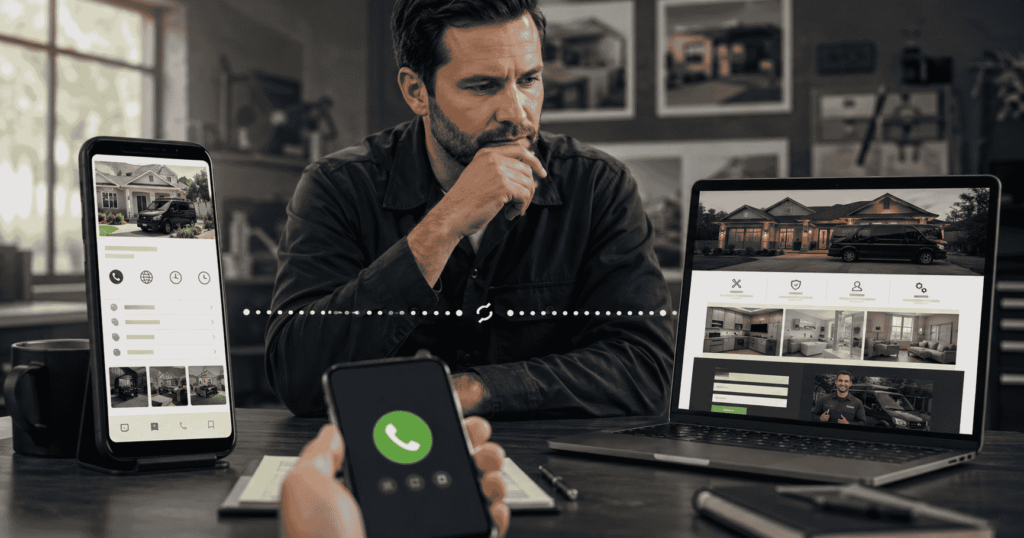
A local service business should fix the first broken part of the customer journey—not automatically choose the Google Business Profile or the website.
Fix the Google Business Profile first when its business information is inaccurate, its service is unclear, it attracts the wrong inquiries, or its website link sends people to an unsuitable destination. Fix the website first when relevant local prospects already find the business but cannot understand the service, verify enough trust, or complete the next action after clicking.
Fix both together when they contradict each other. Fix the inquiry process before investing in either one when calls go unanswered, forms fail, booking links break, or the business cannot respond reliably.
The useful question is not, “Which one is more important?” It is:
Where does a relevant local prospect first lose the information, confidence, or ability needed to continue?
This guide provides a practical way to answer that question before paying for more local SEO, a website redesign, new service pages, or wider Google Business Profile work.
Quick decision summary
- Fix the Google Business Profile first when the public business identity, category, services, hours, location or service area, contact details, or website destination are inaccurate or unclear.
- Fix the website first when the right people already find the business but the site fails to explain the service, establish confidence, answer buyer questions, or make contact easy.
- Fix both together when they display conflicting services, locations, hours, contact information, business names, or customer expectations.
- Fix the action path first when calls, forms, bookings, notifications, or internal responses do not work reliably.
- Do not buy more visibility before diagnosing the current path. More views cannot repair an unclear offer, weak destination page, or broken inquiry process.
The practical rule is simple: begin with the earliest meaningful failure.
The Google Business Profile and website do different jobs
A Google Business Profile and a website support the same local customer journey, but they do not perform the same role.
The Business Profile can help a potential customer discover the business, confirm essential information, review visible proof, and take an immediate action such as calling, requesting directions, visiting the website, or using another available contact option.
The website can support the deeper decision. It can explain individual services, show relevant evidence, define service areas and limitations, clarify process, distinguish one offer from another, answer detailed questions, and support a more informed inquiry.
For an urgent or straightforward local service, someone may call directly from the Profile without visiting the website. For a customized, expensive, unfamiliar, sensitive, or higher-trust service, the website may play a much larger role before the prospect feels comfortable making contact.
The Google Business Profile may earn attention. The website often has to earn enough confidence for the next decision.
Neither asset replaces the other in every situation. Their relative importance depends on the service, the customer’s risk, the amount of explanation required, and where the current journey is failing.
What each one should contribute
| Decision stage | Google Business Profile | Website |
|---|---|---|
| Discovery | Help the business appear and be recognized in relevant local Search and Maps experiences. | Support visibility for service, location, comparison, and decision-stage searches beyond the Profile. |
| Immediate relevance | Show the real business, core category, services, location or service area, hours, and practical contact options. | Explain who each service is for, what problem it addresses, and whether the visitor is a suitable fit. |
| Early trust | Provide accurate business details, genuine reviews, useful photos, and recognizable public information. | Provide deeper proof, process information, examples, qualifications where applicable, boundaries, and detailed answers. |
| Decision support | Give enough information for a quick local comparison or immediate action. | Answer questions that cannot reasonably fit within a Profile and help a serious prospect evaluate the service. |
| Action | Support available actions such as calls, website visits, directions, messages, or bookings. | Support quote requests, consultations, detailed inquiries, bookings, and service-specific next steps. |
A strong Profile can still send someone to a weak website. A strong website can still be undermined by an inaccurate Profile. Both can appear professional while a broken phone, failed form notification, or poor response process loses the inquiry.
The Five-Layer Local Visibility Decision
Use the following five layers to identify the first failure. They follow the order in which a local prospect typically moves from discovery toward contact.
1. Discovery: Can the right local prospect find the business?
The first layer is discovery. When the business is not being encountered for relevant local needs, the website may never receive a visit and the Profile may never receive a useful action.
Google explains local results mainly through relevance, distance, and prominence. Distance is partly determined by the searcher’s location and cannot simply be optimized away. Google also states that there is no way to request or pay for a better local ranking.
Read Google’s current local-ranking guidance.
At this stage, review questions such as:
- Is the correct Business Profile claimed, verified, and controlled by the business?
- Does the Profile represent the actual business name rather than a marketing variation?
- Are the primary category, services, location, and service area accurate?
- Does the business appear for relevant service needs or mainly for unrelated searches?
- Can the intended customer recognize what the business actually provides?
- Is the Profile affected by an old, duplicate, or conflicting business presence?
Fix the Profile first when inaccurate or incomplete Profile information is weakening discovery or attracting the wrong audience.
Do not respond by adding promotional phrases, locations, or service keywords to the business name unless they are genuinely part of the real-world name. Google’s guidelines require the Profile name to reflect the name used consistently on the storefront, website, stationery, and other real business representations.
Review Google’s guidelines for representing a business.
2. Relevance: Does the prospect recognize the correct service?
A business can be visible without appearing relevant enough to choose. A person may find the Profile but remain unsure whether the business provides the exact service, serves the required area, handles the type of project, or is suitable for the situation.
The Profile should establish immediate relevance. The website should continue it.
- Does the Profile make the primary service understandable?
- Does the selected category accurately describe the main business?
- Does the Profile describe the services the business genuinely provides?
- Does the service area match where the business actually works?
- Does the website link lead to a page that continues the same service need?
- Does the destination page immediately explain the service and intended customer?
- Are irrelevant inquiries showing that the public message is too broad or misleading?
Fix the Profile first when its category, services, service area, or website destination creates the mismatch.
Fix the website first when the Profile creates the correct expectation but the clicked page becomes generic, vague, or unrelated.
A common failure is sending every Profile visitor to a broad homepage that does not quickly route the person toward the relevant service. A homepage can be the correct destination when it explains and organizes several service paths well. A focused service page may be stronger when the Profile and likely search need center on one clear service.
For a more detailed evaluation of this handoff, read Why Local Service Pages Fail to Turn Google Searches Into Inquiries.
3. Trust: Do the Profile and website tell one credible story?
Local prospects often move between the Profile and website while deciding whether to call. Trust weakens when those two sources appear to describe different businesses.
- Do the business name, phone number, location or service area, and hours agree?
- Do the Profile and website describe the same core services?
- Does the website support the claims introduced by the Profile?
- Are the reviews, examples, credentials, and qualifications genuine and relevant?
- Does the website explain enough process and scope to reduce uncertainty?
- Are contact expectations accurate and realistic?
- Does the business look recognizable across its public presence?
Fix both together when the public information conflicts. Correcting only one side leaves the prospect with two versions of the business.
Consistency does not mean copying identical paragraphs into every platform. It means keeping the underlying facts, service promise, operating information, and customer expectations aligned.
The Profile may provide the condensed version. The website should add depth without changing the essential story.
Use the Local Trust Consistency Test when the business appears legitimate but local prospects may still be hesitating before contact.
4. Decision depth: Can the website answer what the Profile cannot?
A Business Profile has limited space and a different purpose. It cannot always explain a complex service, compare options, define a custom process, describe project boundaries, answer several objections, or help a prospect judge whether a specialized service is appropriate.
This is where the website becomes more important.
- Does each important service have enough information to support a real decision?
- Can the visitor understand who the service is for?
- Does the page explain the problem, service, process, proof, and next step?
- Are meaningful limitations or exclusions stated honestly?
- Does the website distinguish similar services clearly?
- Does the content answer the questions a serious buyer is likely to ask before contact?
- Does the page show why the business is relevant without relying on generic praise?
Fix the website first when the Profile earns attention but the service requires more explanation than the website currently provides.
This often applies to professional services, advisory work, customized projects, high-consideration purchases, or services where the customer must compare suitability rather than simply choose the nearest available provider.
When the main weakness is thin service content, vague positioning, poor page hierarchy, or unanswered buyer questions, focused SEO website content may be a more responsible first investment than rebuilding the entire website.
5. Action: Can the prospect complete the next step?
Visibility, relevance, and trust do not become inquiries when the action path fails.
- Does the Profile use the correct phone number and website destination?
- Can a mobile visitor call without copying a number manually?
- Does the website form submit correctly?
- Do form notifications reach the right person?
- Does the booking system work on a phone?
- Does the call to action explain what the visitor should do?
- Does the confirmation message explain what happens next?
- Does the business respond reliably after an inquiry arrives?
Fix the broken action first regardless of whether it belongs to the Profile, website, booking platform, phone system, or internal response process.
A local business should not pay for more exposure while its primary contact route is broken. That only sends more prospects into the same failure.
Decision matrix: what should you fix first?
| What you are seeing | First priority | Reason |
|---|---|---|
| The business name, phone number, hours, location, service area, category, or website link is inaccurate. | Google Business Profile | The prospect receives incorrect or unclear information before reaching the website. |
| The Profile attracts inquiries for services the business does not provide. | Profile, then website | The Profile may create the wrong expectation, while the website should clarify real service boundaries. |
| The Profile receives website clicks, but the website produces few suitable inquiries. | Website | Discovery is working well enough to earn a click; the deeper decision path may be failing. |
| The Profile link opens a generic, outdated, or unrelated homepage. | Website destination | The local service need is not being continued after the click. |
| The Profile and website show different contact details, hours, service areas, or offers. | Both together | Correcting only one leaves a public contradiction. |
| Visitors understand the service but hesitate because proof and process are weak. | Website | The prospect needs deeper trust and decision-support information. |
| Calls and forms arrive, but responses are slow or inconsistent. | Internal inquiry process | The marketing assets are producing opportunities that the business operation is losing. |
| The Profile is accurate, but the website has no focused pages for important services. | Website content and structure | The Profile cannot provide all the information needed for each service decision. |
| Neither asset is accurate or useful. | Profile baseline, then website foundation | Establish a truthful discovery presence first, then build enough website depth to support the decision. |
| The business is considering WordPress or Wix solely to improve Maps rankings. | Diagnose before migrating | A platform change does not automatically correct Profile, relevance, trust, service-page, or inquiry-path problems. |
When the specific symptom is Profile visibility without enough calls, bookings, website clicks, or serious inquiries, use the more detailed guide: Google Business Profile Views but Few Calls? What to Check Before Paying for More Local SEO.
Fix the Google Business Profile first when the problem happens before the click
The Profile should usually receive priority when the customer encounters the problem before reaching the website.
- The business has not claimed or verified the correct Profile.
- The real-world business name is not represented accurately.
- The phone number, hours, location, or service area is wrong.
- The Profile uses an unsuitable primary category.
- The services are unclear, incomplete, or misleading.
- The website link points to an old domain or unsuitable page.
- The business has duplicate or conflicting Profiles.
- The business recently moved, rebranded, changed its services, or changed its operating model.
- The Profile does not accurately reflect whether customers visit the location or the business travels to customers.
Correct the facts before adding promotional activity. More photos, posts, citations, or external marketing cannot make inaccurate business information trustworthy.
Google advises businesses to provide complete and detailed information to help it understand the business and match the Profile to relevant searches. “Complete” should not be interpreted as permission to fill every field with repeated keywords. Accuracy and real-world representation come first.
Fix the website first when the problem happens after the click
The website should usually receive priority when the Profile is accurate enough to attract relevant attention, but the visitor cannot make a confident decision after clicking.
- The homepage does not explain the primary service clearly.
- The linked page does not match the local service need.
- Important services have no focused pages.
- The service page contains generic claims but little useful information.
- The site does not explain customer fit, process, scope, or meaningful limitations.
- Proof is weak, unrelated, difficult to verify, or difficult to find.
- The website does not make the real service area understandable.
- The mobile layout makes calls, forms, or bookings difficult.
- The page asks for contact before giving the visitor enough reason to act.
- The platform or current structure prevents necessary improvements.
A better website cannot guarantee local visibility or inquiries. It gives the business a stronger place to continue the prospect’s decision after discovery occurs.
When the broader structure, trust, mobile experience, content, and inquiry path are all weak, a website redesign may be more appropriate than patching one isolated section.
Fix both together when the public story has split
Some problems cannot be repaired responsibly on one side only.
- A new business name appears on the website but not on the Profile.
- The Profile promotes a service the website barely mentions.
- The website describes a service area that conflicts with the Profile.
- The Profile directs people to a homepage intended for a different audience.
- Phone numbers, hours, address information, or contact expectations differ.
- The business has changed from a storefront to a service-area operation, or the reverse, but only one asset reflects the change.
- The Profile creates a promise that the website cannot support with information or proof.
Start by confirming the real business facts. Then decide how much detail belongs in each location.
The Profile should remain concise, accurate, and useful for immediate local decisions. The website should provide greater depth without presenting a different identity or offer.
Sometimes neither one is the first problem
A Profile-versus-website comparison becomes misleading when the real failure sits outside both assets.
- Calls are not answered. More call actions will not solve an unreliable response process.
- Form notifications are lost. The website may be generating inquiries the business never sees.
- The service offer is commercially unclear. Better design cannot fully repair an offer with no defined audience, scope, or value.
- The business promotes areas it cannot serve. Increased visibility creates unsuitable inquiries.
- The business lacks capacity. More demand may create a worse customer experience rather than useful growth.
- The service does not match the demand being reached. Clear marketing cannot manufacture suitable demand in every market.
- Prices, schedules, or availability are misrepresented. The problem is an operating-information failure, not merely an SEO problem.
- The customer experience is poor. Marketing cannot permanently compensate for repeated communication, fulfillment, or service-quality problems.
This is why the diagnosis should examine the full path before prescribing Profile optimization, content work, a platform migration, or a complete rebuild.
The safest order of work
For many local service businesses, the following sequence prevents unnecessary spending and makes later performance easier to interpret.
- Confirm the real business information. Establish the correct name, contact details, location or service area, hours, core services, and operating model.
- Verify the Profile baseline. Confirm ownership, accuracy, categories, services, contact options, and website destination.
- Test every action path. Test calls, forms, booking links, notifications, confirmations, and mobile usability.
- Compare the Profile promise with the destination page. The website should continue the service need, local relevance, trust, and action that earned the click.
- Strengthen the primary service page. Improve the service explanation, audience fit, proof, process, boundaries, FAQs, and inquiry route.
- Align public trust information. Correct meaningful inconsistencies across the Profile, website, contact information, and operating details.
- Measure useful actions. Review Profile interactions, website behavior, completed inquiries, and inquiry quality rather than relying on views alone.
- Increase promotion last. More local SEO, content, advertising, or listing work makes greater sense after the destination and response process are ready.
How to measure whether you fixed the right problem
Business Profile performance can provide information about visibility and available interactions across Google Search and Maps. Depending on the business and enabled features, this can include website clicks, calls, directions, messages, bookings, and other actions.
Read Google’s current guidance on Business Profile and Analytics data.
These figures are useful diagnostic signals, but they are not the same as confirmed customers or revenue. A website click does not show whether the visitor understood the page. A call action does not prove that a useful conversation occurred. A form submission does not prove that the inquiry was suitable.
| Measurement layer | What to review | What it helps diagnose |
|---|---|---|
| Profile discovery | Views, search visibility, and available discovery information. | Whether the business is being encountered, not whether every encounter is relevant. |
| Profile interaction | Website clicks, call actions, directions, bookings, messages, and other available interactions. | Whether discovery is producing a next step inside the Profile. |
| Website behavior | Landing-page visits, click-to-call actions, form starts, completed forms, bookings, and important page journeys. | Whether the website continues the decision after the click. |
| Inquiry quality | Service fit, location fit, project relevance, readiness, and commercial suitability. | Whether the activity is useful to the real business. |
| Operational response | Missed calls, response times, failed notifications, booking handling, and follow-up. | Whether the business is converting available opportunities into real conversations. |
Compare the layer you changed with the outcome that should reasonably respond.
- After correcting Profile information, review whether the inquiries and website visits become more relevant.
- After replacing the destination page, review visitor behavior, useful actions, and inquiry quality.
- After repairing mobile calls or forms, confirm that completed actions and notifications are working.
- After clarifying services, review whether unsuitable inquiries decline and suitable inquiries become more specific.
- After strengthening trust, look for better engagement with proof, process, FAQs, and contact routes—not merely more total sessions.
Do not change several unrelated parts of the system at once unless the contradictions require coordinated correction. When every variable changes together, it becomes harder to learn which problem mattered.
Do not choose a website platform as a local-ranking shortcut
WordPress and Wix can both support a credible local service website. Neither platform automatically corrects an inaccurate Business Profile, an unclear service, weak proof, a poor destination page, or a broken inquiry process.
Google’s local-ranking guidance explains relevance, distance, and prominence. It does not present the website platform’s brand name as an automatic local-ranking advantage.
Platform choice still matters operationally. It affects how easily the business can create and maintain service pages, update public information, connect forms and analytics, protect account ownership, manage performance, and adapt the website over time.
Use WordPress vs. Wix for a Local Service Business when the current platform is genuinely part of the decision. Do not migrate solely because someone claims a different platform will automatically improve Google Maps visibility.
Questions to answer before paying for more local SEO
- Is the correct business being represented accurately?
- Is the intended service easy to recognize from the Profile?
- Does the website link lead to the best available destination?
- Does that page continue the same service and local context?
- Can the visitor verify enough trust to feel comfortable continuing?
- Does the website answer the questions the Profile cannot?
- Can someone call, book, or inquire easily on a phone?
- Do notifications and internal responses work reliably?
- Are the inquiries suitable for the service and area?
- What specific failure is additional local SEO supposed to correct?
If the last question cannot be answered clearly, the next purchase may be based on hope rather than diagnosis.
Frequently asked questions
Do I need a website when I already have a Google Business Profile?
Not every local customer will visit a website before calling, but a website becomes especially important when the service requires explanation, proof, comparison, process information, qualification, or a detailed inquiry. The Profile can support discovery and immediate action. The website gives the business more control over the deeper decision.
Can a good website compensate for a weak Google Business Profile?
Only partly. A strong website can support organic visibility and provide deeper information, but it cannot correct inaccurate Profile details shown to a customer before the click. When the Profile is wrong or misleading, correct it directly rather than expecting the website to compensate.
Can a strong Google Business Profile compensate for a poor website?
It may generate direct calls for straightforward services, but it cannot fully replace a website when customers need detailed service information, proof, process clarity, or a more involved inquiry. A weak website can also reduce confidence after the Profile earns the click.
Should my Google Business Profile link to my homepage or a service page?
Use the destination that best continues the likely customer need. A homepage can work when it explains the business clearly and routes visitors quickly. A focused service page may be more useful when one service dominates the local decision. Do not choose a page merely because it contains more keywords.
Should I fix the website before starting local SEO?
Fix critical website problems first when the destination page is unclear, untrustworthy, difficult to use, or unable to accept inquiries. Basic Profile accuracy and website repair can also be handled together. The goal is to avoid increasing traffic to a path that is already failing.
Will fixing my website improve my Google Maps ranking?
A better website is not a guaranteed Maps-ranking tactic. It can improve the clarity, usefulness, trust, and conversion path available to people who discover the business. Google explains local rankings mainly through relevance, distance, and prominence, and no responsible provider should guarantee a specific Maps position.
What should I fix when the Profile gets views but no calls?
Check whether the right people are finding the business, whether the service is clear, whether the visible proof supports the decision, whether the website destination continues the need, and whether the mobile call or inquiry path works. Views alone do not identify which of those layers is failing.
How do I know whether I need a Profile review or a full website audit?
A focused Profile and local-inquiry review is appropriate when the main question concerns local discovery, Profile accuracy, the website handoff, local trust consistency, or mobile contact. A broader website audit is more appropriate when the site also has wider problems involving structure, content, SEO, speed, trust, platform limitations, or conversion paths across several pages.
The practical next step
Do not begin by choosing between the Google Business Profile and the website in isolation. Trace the real path:
Discovery → relevance → trust → decision support → action → business response.
Find the first meaningful failure and correct that layer before paying to push more people toward it.
When the problem appears to sit between the Profile, website destination, trust information, and contact path, review the Google Business Profile and Local Inquiry Review.
When the entire website may be contributing to the problem, begin with a website audit before committing to a redesign, migration, or wider content project.
The goal is not to declare one asset universally more important. It is to invest first in the part of the local customer journey that is currently preventing a suitable prospect from taking the next sensible step.